





Table of Contents Show
As we wind through the historic “36 Streets” of Hanoi’s Old Quarter, most travellers are drawn to the silk shops of Hàng Gai or the silver of Hàng Bạc. But for those seeking the ultimate niche in Vietnamese heritage the “ghostly” art of Hang Trong folk painting I invite you to turn onto the street of Hàng Trống.
In the 19th century, this was a bustling corridor of art, yet today, the heart of this “village within a city” beats in the hands of a singular master. This ancient tradition is a sophisticated fusion of folk belief, royal elegance, and a unique “water-ink” technique that creates a bridge between the mortal and the divine.
Read more interesting posts here:
- Funny Translations in Vietnam: Ridiculous Signs That Make No Sense (But Are Amazing)
- Sky Farms in Vietnam: Incredible Highland Terraces Hidden Above the Clouds
- Best Nature Escapes Southern Vietnam: 5 Incredible Hidden Getaways You’ve Never Heard Of
The Art of the “Two-Brush” Dance in Hang Trong Folk Painting

Hang Trong folk painting is distinct from the more famous Đông Hồ woodblocks. While Đông Hồ is rustic and earthy, Hàng Trống is refined, designed for the urban elite and the ornate altars of temples. But the true magic lies in the “vờn màu” technique.
As your guide, I will take you into a quiet studio where time stands still. You will see an artist holding two brushes in one hand one soaked in pigment, the other in pure water. With a rhythmic, sweeping motion, he applies the color and instantly blurs it with the water-brush. This creates a mesmerizing gradient, a “smoke-and-shadow” effect that gives the figures of the Five Tigers or the Holy Mothers a three-dimensional, ethereal glow. It is a dance of moisture and light that no printing press can ever replicate.
Guardians of the Altar: The Spiritual Power of the Five Tigers
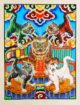
For the global seeker, these paintings are not just décor; they are spiritual maps. The most iconic Hang Trong folk painting subject is the “Ngũ Hổ” (Five Tigers) five celestial guardians representing the five elements of the universe. In Vietnamese folk belief, these tigers protect the home from malevolent spirits.
When you look closely at a Hàng Trống tiger, you’ll notice its eyes seem to follow you. The artisans believe that the final stroke the “dotting of the pupils” is when the spirit enters the paper. There is an ancient wisdom here: that art is not a representation of life, but a vessel for it. To own a piece of Hang Trong folk painting is to invite a guardian into your space, a tradition that has anchored the spiritual life of Hanoi families for centuries.
A Legacy on a Single Thread: Preserving Hang Trong Folk Painting

The reason this is “super niche” is because Hang Trong folk painting is currently hanging by a thread. In 2026, there is only one master craftsman left who possesses the full knowledge of the ancestral woodblocks and the “two-brush” technique.
To visit his workshop is to participate in an act of cultural rescue. We will look at woodblocks carved over a hundred years ago, their edges smoothed by the hands of five generations. We will see the Dó paper made from the bark of the rhamnoneuron tree which is as durable as cloth and as soft as silk. The wisdom shared here is a poignant one: perfection cannot be rushed. A single large-scale painting can take weeks of meditative labor, where the humidity of the Hanoi air must be perfectly balanced for the ink to “bloom” correctly.
The Connoisseur’s Urban Trek to Hanoi’s Old Quarter

I recommend this journey for the traveler who finds beauty in the “last of its kind.” It is for the art historian, the spiritual seeker, and the traveler who understands that a city’s soul is found in its smallest, quietest corners.
As the sun sets over Hoàn Kiếm Lake and the neon lights of the modern city flicker on, the silent tigers of Hàng Trống remain in their paper kingdoms, watching over us. They remind us that even in a world of digital replication, the human hand can still create something truly divine.
Want to step inside the hidden studios of Hanoi’s master artisans? Explore our curated craft heritage tours and witness the magic of Hang Trong folk painting firsthand: Gongs Show (Cong Chieng Show) Half Day Tour
Conclusion
Hang Trong folk painting is more than just a craft; it is the spiritual pulse of old Hanoi. By witnessing the “two-brush” dance and the ink of the ancients, you aren’t just looking at art you are helping a century-old tradition survive. Let us walk the street of the drums and find the soul of Hanoi, one brushstroke at a time.
FAQ
1. What is Hang Trong folk painting?
It is a traditional Vietnamese art form originating from Hàng Trống street in Hanoi, known for its sophisticated “two-brush” coloring technique and spiritual themes.
2. How does it differ from Dong Ho painting?
While Dong Ho uses woodblocks for all colors and has a rustic style, Hang Trong folk painting uses woodblocks for outlines only, with colors hand-painted using water-ink gradients.
3. What is the “von mau” technique?
This is a unique “two-brush” method where one brush carries pigment and the other water, allowing the artist to create smooth, ethereal color transitions.
4. What are the common themes in these paintings?
Themes often include spiritual guardians like the Five Tigers, religious figures (Holy Mothers), and decorative scenes representing prosperity and luck.
5. Can I visit a master artisan in Hanoi?
Yes, though only one master remains in the Old Quarter. Visiting his workshop is a rare opportunity to see the survival of this 19th-century urban art form.
Ready to share your mindful travel stories and connect with fellow wanderers? Join our vibrant community in the ExoTrails Community Group and be sure to like the Facebook Page for the latest travel tips, cultural insights, and daily inspiration!
Klook.com


