




Table of Contents Show
If you’re looking for the ultimate “off-the-beaten-path” adventure the kind that makes you forget you’re only 90 minutes from Hanoi you head to the Vân Long Nature Reserve. While the world is mesmerized by the boat-hubs of Tam Cốc, Vân Long remains the quiet, mirror-like sanctuary of the Delacour’s Langur, one of the rarest primates on the planet.
For those interested in wildlife spotting Ninh Binh, this is a trek for the observer, the stealth-specialist, and anyone who understands that the most profound encounters with nature require patience and a very light footprint.
Read more interesting posts here:
Van Long: The Sanctuary for Wildlife Spotting Ninh Binh
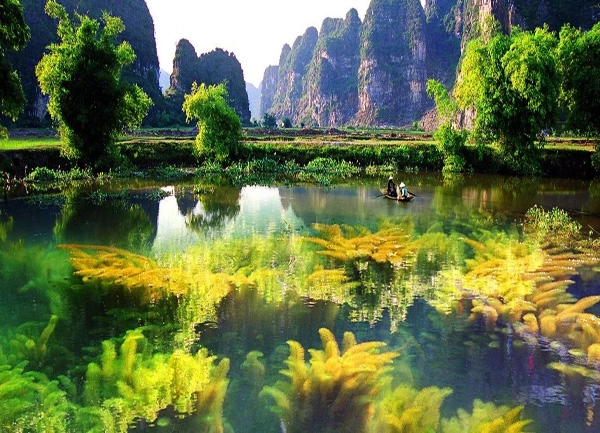
Vân Long isn’t just a wetland; it’s a flooded limestone labyrinth. To see the langurs, we don’t just stay in the boat. We navigate the “shoreline scrambles” narrow, muddy trails that hug the base of the massive karst walls.
- The Physical Discipline: This is about controlled movement. You’re navigating slippery limestone and dense aquatic reeds, often moving in total silence to avoid alerting the “Silver-Ghosts” above. It’s a test of your agility and your ability to blend into the landscape.
- The “Monkey-Watch” Ledges: We hike to specific, elevated “watch-points” hidden in the cliffs. These are the “balconies” of the karst where the langurs distinguished by their striking black bodies and white “shorts” come to sunbathe on the sheer rock faces. Witnessing this is a highlight of wildlife spotting Ninh Binh, showing a humbling display of evolutionary perfection.
Sapa’s Buffalo Trails vs. Ninh Binh’s “Langur-Lines”

The experience of wildlife spotting Ninh Binh in the karst is a sharp departure from the high-altitude forests of the north:
- The Backdrop: In Sapa, you’re looking through dense, vertical jungle canopy. In Vân Long, you’re looking at exposed limestone “stadiums.” The visibility is high, but the stakes are higher; because the rock is so open, the animals see you as clearly as you see them.
- The Stealth Factor: Sapa’s trails are often busy with the sounds of bells and mountain life. In Vân Long, the only sound is the oar dipping into the water or the rustle of a langur in a wild fig tree. It is “Passive Adventure” at its peak.
- The Reward: While Sapa gives you the sweeping scale of human engineering (the terraces), wildlife spotting Ninh Binh gives you a glimpse into a world that feels prehistoric.
Why a Local Guide is Essential for Wildlife Spotting Ninh Binh

You could spend all day in Vân Long and see nothing but water and stone. A local guide is your “sensory amplifier” for successful wildlife spotting Ninh Binh:
- The “Langur-Clock”: The langurs have a strict social schedule. A guide knows exactly when they descend to the lower cliffs for water and when they retreat to the high-altitude caves to sleep. They save you hours of looking at empty rock.
- The “Silent-Stroke” Technique: To get close to the nesting sites, your guide uses a specialized, no-splash rowing technique. It’s the difference between seeing a langur’s tail as it vanishes and watching a family interact for twenty minutes.
- The Botanical Clues: Your guide will point out the “Langur-Larder” the specific wild fruits and leaves that indicate a troop is nearby.
Ready to see the rarest primates of Vietnam in their natural habitat? Explore our guided nature expeditions and book your wildlife adventure today: 2D1N Mai Chau Valley & Pu Luong Nature Preserve Tour from Hanoi
Conclusion
Wildlife spotting Ninh Binh is a reminder of the power of stillness. In a world that is increasingly loud and fast, Vân Long offers a rare glimpse into a world of “Silver-Ghosts” and prehistoric landscapes. By moving with the quiet intensity of a hunter and the respect of a guest, you’ll discover that the best adventures in Vietnam are the ones that leave you breathless and silent.
FAQ
1. Where is the best place for wildlife spotting Ninh Binh?
Vân Long Nature Reserve is the premier location, as it is the largest wetland nature reserve in the Red River Delta and home to the endangered Delacour’s Langur.
2. When is the best time of day to see the Delacour’s Langur?
Early morning (6:00 AM – 9:00 AM) or late afternoon (4:00 PM – 6:00 PM) are the best times, as the langurs are most active and come down to the lower cliffs.
3. Do I need binoculars for wildlife spotting in Ninh Binh?
While you can see them with the naked eye, a good pair of binoculars is highly recommended to observe their social interactions and facial expressions from a distance.
4. Is Vân Long Nature Reserve crowded like Tam Cốc?
No, Vân Long is much quieter and less commercialized, making it an ideal “off-the-beaten-path” destination for nature lovers and photographers.
5. Is a guide necessary for tracking wildlife in Vân Long?
Yes. Local guides know the langurs’ movements and the specific “watch-points” in the limestone cliffs that are almost impossible for visitors to find on their own.
Ready to uncover more ancient legends and connect with fellow cultural explorers? Follow our Facebook Page and join our ExoTrails Community Group to connect with fellow explorers and stay updated on the latest trails!
Klook.com


