





Table of Contents Show
If you travel deep enough into the district of Nho Quan, where the mountains begin to merge with the ancient shadows of the national park, the landscape throws you a curveball that feels like a geographical glitch. Rising out of the emerald canopy is a sight that feels like a European daydream: the Chau Son Monastery Ninh Binh (Đan Viện Châu Sơn).
As an adventurer who usually measures progress in vertical meters and litres of sweat, coming upon this red-brick citadel is a surreal experience. It is a 1939 masterpiece of Gothic architecture, built entirely of raw, unplastered brick, standing in silent defiance of the tropical humidity.
Read more interesting posts here:
- Ha Giang Motorbike Loop: Discover the Epic Off-Grid Routes Most Travelers Never Discover
- Pristine Coastal Landscapes: 5 Hidden Shores in Vietnam for an Unforgettable Escape
- Vietnam Camping Culture: The Epic Campfire Experiences Reviving Outdoor Travel
The Gothic Architecture of Chau Son Monastery Ninh Binh

Most of Ninh Bình is a story of grey stone and water a monochromatic world of limestone and river silt. Chau Son Monastery Ninh Binh, however, is a story of clay and fire. The monks who founded this sanctuary opted for a “raw” aesthetic that has become its defining characteristic. There is no plaster, no whitewash, and no paint to hide the craftsmanship. Every column, arch, and buttress is a testament to the patient placement of individual bricks.
The visual contrast is nothing short of electric. In the late afternoon, the unbaked bricks absorb the sun’s warmth, glowing a deep, vibrant crimson. When framed against the jagged, dark-grey “fingers” of the surrounding peaks, the monastery looks less like a building and more like a living organism breathing in the heart of the valley.
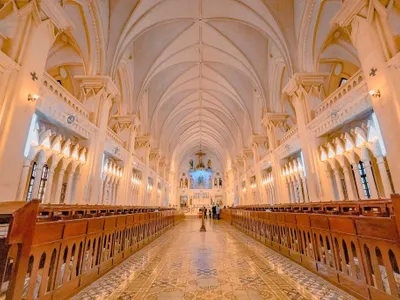
At Chau Son Monastery Ninh Binh, you enter a “Zero-Acoustic” environment; moving from the hum of a motorbike through the monastery gates is like hitting a mute button on the world. The geometric symmetry of the arches and the silent, pine-lined paths provide a sensory reset that is rare in the high-energy pulse of the Red River Delta. It is a “Paradise Garden” where the architecture serves as a filter for the chaos of the outside world.
A Tale of Two Altars: From Sapa to Nho Quan

For those who have trekked the northern circuits, the contrast between the colonial remnants in the mountains and the lowland valleys is striking. In Sapa, the iconic Stone Church serves as a public landmark in a bustling mountain town, built of cold, grey stone to survive the high-altitude alpine mist.
Chau Son Monastery Ninh Binh, by contrast, is a private, contemplative retreat. It uses the warmth of the Vietnamese earth the very soil of the valley to create a fortress of solitude. It isn’t just a site to photograph; it is a space to inhabit in silence. While the Sapa church belongs to the community, Châu Sơn feels like it belongs to the mountain itself.
Finding Peace at Chau Son Monastery Ninh Binh

In the busy landscape of global travel, we often chase the loudest, most expansive views. We hunt for the highest peaks and the longest caves, but Chau Son Monastery Ninh Binh reminds us that quiet is a luxury of its own. It is a working monastery, not a museum, which means the air here is heavy with a different kind of energy the energy of discipline and devotion.
On your next mission toward the western mountains, leave the crowded boat docks of the central districts behind. Set your compass for the “Back Door” of the Cúc Phương wilderness. Trade your trail-speed for a slow walk and step into the red-brick shadow of these Gothic walls. Feel the heat radiating from the bricks, watch the light cut through the stained glass, and listen to the absolute stillness of the valley.
Conclusion
Visiting Chau Son Monastery Ninh Binh offers a rare sensory reset that stays with you long after you leave its gates. This red-brick Gothic masterpiece is more than just a sanctuary; it is a fortress of solitude in the heart of Nho Quan. Whether you are an architecture enthusiast or an explorer seeking a moment of absolute stillness, this hidden monastery provides a profound discovery at the intersection of faith and nature.
Ready to share your own family adventure stories and discover new kid-friendly routes? Follow our Facebook Page and join our ExoTrails Community Group to connect with fellow explorers and stay updated on the latest trails!
Klook.com


